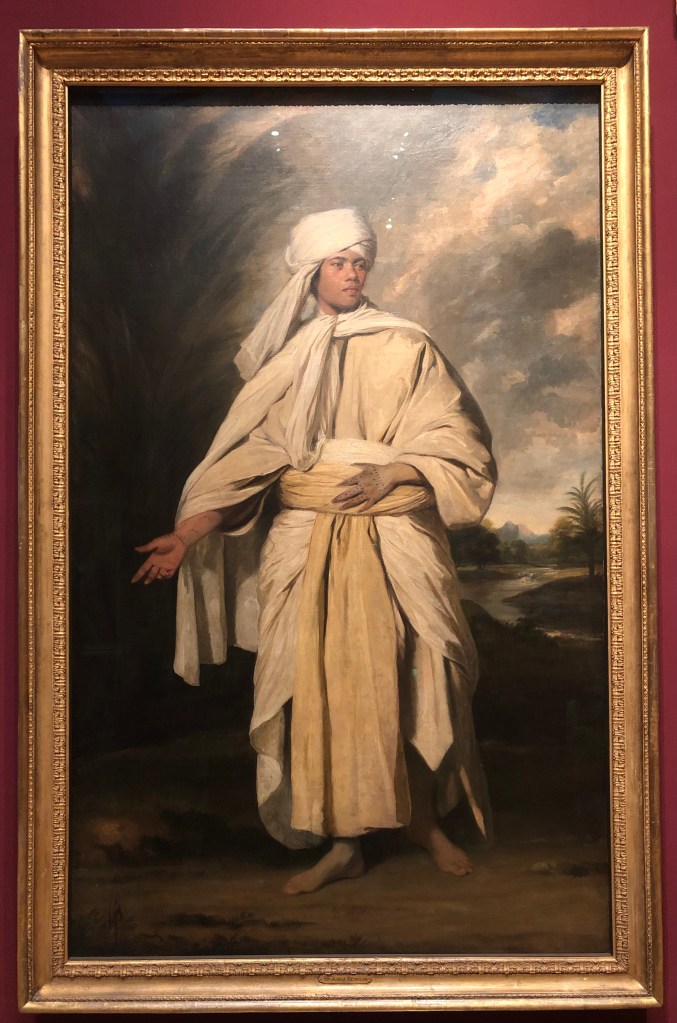
This portrait was painted by Sir. Joshua Reynolds in about 1776. It was recently the subject of a national campaign in the UK to ‘save’ it for the nation. ‘Saving’ it meant acquiring it for value from its Irish owner, John Magnier, by utilising rules relating to the exportation of significant works of art and other cultural objects. I would like to have a brief look at the how these rules work in the UK (as they did successfully in this case) and see if we have anything similar in Ireland. It is not a small thing to interfere with a person’s property rights to such an extent, and clearly there must be a balance struck between the rights of the owner of a work of art (or piece of cultural heritage), and the interest of the state in preventing objects of significance from being exported.
How the painting ended up in Magnier’s possession and thereafter was ‘saved’ for the UK.
The painting was displayed at Castle Howard in North Yorkshire for 200 years before being sold by Sotheby’s in 2001 for £10.3 million.[1] The Tate had previously rejected an offer by the owner, Simon Howard, to purchase it for £5.5 million[2] and because of this refusal, Howard decided to sell it through Sotheby’s. Magnier bought the painting at the auction, and applied for an export licence, stating that the value of the painting was £12.5 million. The export licence was refused by the Reviewing Committee on the Export of Works of Art. An attempt was made to raise the money then to buy the painting from Magnier but he refused to sell. He also refused to exhibit the work in the UK. Stephen Deuchar, former director of Tate Britain is quoted as saying ‘It’s obviously a shame that the owner, piqued by our government’s quite correct refusal to let him export it permanently to Ireland, has preferred to keep it in store rather than lend it on a long-term basis to a UK museum or gallery’.[3]
In 2005, he was granted a temporary licence for 6 and a half years and the painting was displayed in the National Gallery of Ireland. It returned to the UK in 2012.
10 years later, Magnier again applied to export the painting. This time the value was established to be £50 million. A 12-month export bar was put in place to allow funding to take place in order to purchase the work. Through a combination of public and private donations, the work was purchased jointly by the National Portrait Gallery and the Getty Museum in Los Angeles. It truly was a large campaign, with many players involved and articles and letters written.[4] Sir David Attenborough had spearheaded the first attempt in the early 2000s. The rules surrounding the export of objects of cultural interest from the UK do not allow the government to force people to sell their items. They are simply prevented from exporting the item for a period of time to allow money to be raised.
The Reviewing Committee on the Export of Works of Art.
Cultural objects over a certain age and value in the UK require an export licence. When an application is made, it may be referred to an expert adviser for an opinion. They will assess the object to determine if it falls under one or more of the Waverly Criteria.[5] These criteria are:
- Is it closely connected with our history and national life?
- Is it of outstanding aesthetic importance?
- Is it of outstanding significance for the study of some particular branch of art, learning or history?
The object need not be British in origin. If the adviser objects to the exportation, the matter is referred to the Committee which makes a recommendation to the Department of Culture, Media and Sport. This is to provide the UK with an opportunity to retain goods deemed to be of outstanding national importance.[6]
The Reviewing Committee was set up in 1952 following the recommendations of the Waverly Committee. Each year the 8-person group compiles a report to advise the government that certain ‘national treasures’ should have their export licences deferred to allow time for money to be raised for their purchase. This will be for a period of 3 or 4 months with the possibility of an extension should there be any interest in purchasing the object. This can also be a private purchase as the purpose is to keep the objects in the UK.
It used to be the case that if you didn’t want to sell, you didn’t have to. However, your export licence would not be granted so the object would have to remain in the UK. This is what happened to John Magnier on his first attempt. New rules about legally binding offers have now been introduced however (although Magnier’s second application for an export licence was made prior to these rules coming into force). After the first deferral period, owners may withdraw and keep their object. If they agree to a purchaser however and fundraising is successful, the must sell.[7] The rationale was that it would be a huge waste to go to the trouble of fundraising, only for the offer to be rejected. [8]
And there we have it. It gives a lot of power to the British Government to retain objects within its borders, but they must pay for them at a fair market value. Other European countries have similar (and sometimes stricter) systems relating to items of national importance, but what about Ireland?
Irish export rules regarding cultural objects
Different institutions/government departments are responsible for issuing export licences, depending on the nature of the object in question. The National Gallery of Ireland, for instance, is the Cultural Institution authorised to process export licences for paintings and works on paper executed entirely by hand which are being exported within the EU and Northern Ireland.
Sections 49 and 50 of the National Cultural Institutions Act, 1997 set out which items require licences for export. The types of objects to which the section applies are defined, but it also sets out that the minister may add any certain types of cultural items to a register at his/her discretion, even if they don’t meet the criteria. The minister may refuse a licence for any of these objects.
Section 48 sets out that the minister shall ‘establish and maintain a register of cultural objects … whose export from the State would constitute a serious loss to the heritage of Ireland’.
So, it seems the act requires a licence for:
- Any document older than 70 years and over a certain value
- Any painting older that 25 years and over a certain value (of Irish origin or been in the State more than 25 years)
- Any cultural object on the register
- Any archaeological object
- Certain other designated items declared by the minister to fall under the section
Any item on the register may have its export licence delayed for one year. This seems to be for the purpose of allowing the state an opportunity to purchase the object. There are only 47 objects on the register, all but one a painting proposed by the National Gallery in 1997.[9] In 2016, the minister placed a surrender letter written by Pádraig Pearse on the register, after a licence had been applied for. Minister Humphrey’s stated that ‘it was not open to [her] to refuse to grant the licence, but by delaying it for a year, I am providing an opportunity to allow other options to keep the letter in the country to emerge’. [10]
The board of governors of the National Gallery of Ireland reviews applications for artworks on paper and paintings. It would be interesting to find out if they use the Waverly Criteria in their decision making, and what they do if they consider a work of art of substantial national importance. Presumably the minister of the day could quickly add it to the register and delay its exportation.
A list of all export licences for cultural goods, whether for sale, temporary exhibition, or scientific analysis, can be found here.[11] As far as I can find out, only the Pearse letter caused any engagement with licence restrictions of cultural objects. It may be that a significant work of art or object of cultural heritage becomes at risk of being lost to the country before we see how all of the different rules and regulations can interact to potentially keep it in the country.
In conclusion, in Ireland it seems that the State may refuse an export licence only for objects held by State institutions, but must grant licences for all other cultural objects with the slight option to delay it by a year. It is a bit nebulous so I will keep looking into it.
[1] https://en.wikipedia.org/wiki/Portrait_of_Omai
[2] ibid
[3] https://www.theguardian.com/artanddesign/2018/feb/25/joshua-reynolds-portrait-omai-tate-john-magnier-amsterdam–row
[4] https://www.theguardian.com/commentisfree/2023/feb/12/this-glorious-portrait-is-too-precious-a-treasure-to-be-lost-from-our-shores-for-ever
[5] As set out in the Report of the Committee on the Export of Works of Art etc. [Waverley Report] 1952
[6] https://www.artscouncil.org.uk/supporting-arts-museums-and-libraries/export-licensing#t-in-page-nav-3
[7] Statutory Gudance on export licencing December 2020 ibid
[8] https://www.gov.uk/government/consultations/strengthening-the-process-for-retaining-national-treasures/outcome/x
[9] https://www.gov.ie/pdf/?file=https://assets.gov.ie/96266/b0ff164e-53b7-4dea-a42b-472c5c7be08b.pdf#page=null
[10] https://merrionstreet.ie/en/news-room/releases/minister_humphreys_adds_pearse_letter_to_register_of_cultural_objects.html
[11] https://www.gov.ie/en/publication/a72e4-export-of-cultural-goods/#


Leave a Reply